
A tubular pool that tilts by a few millimeters exerts asymmetric pressure on its metal structure and liner. This mechanical stress worsens over time: the welds fatigue, the legs sink further on the more loaded side, and the risk of breakage increases. Correcting this tilt without draining the pool is possible in some cases, but the method used determines both the result and the durability of the pool.
Hydraulic pressure and deformation: what happens in a tilted tubular pool

Water weighs about one ton per cubic meter. In a round pool four meters in diameter filled to normal height, the total mass reaches several tons. When the ground has a level defect, this mass redistributes towards the lowest point.
The vertical tubes on the low side then bear a load greater than that intended by the manufacturer. The punching at the foot of the tube increases, the metal sinks into the ground, creating a localized depression. The liner, pulled downwards, experiences uneven tension that can cause micro-tears at the welds.
This phenomenon is gradual. A barely visible tilt during assembly can become problematic after a few weeks of filling. Before any intervention, the actual gap between the water level and the top edge of the structure must be measured at several opposite points of the pool. If the difference exceeds one centimeter, most manufacturers recommend a complete drain rather than a load-bearing straightening.
Straightening methods for a full tubular pool: shimming and raising the legs
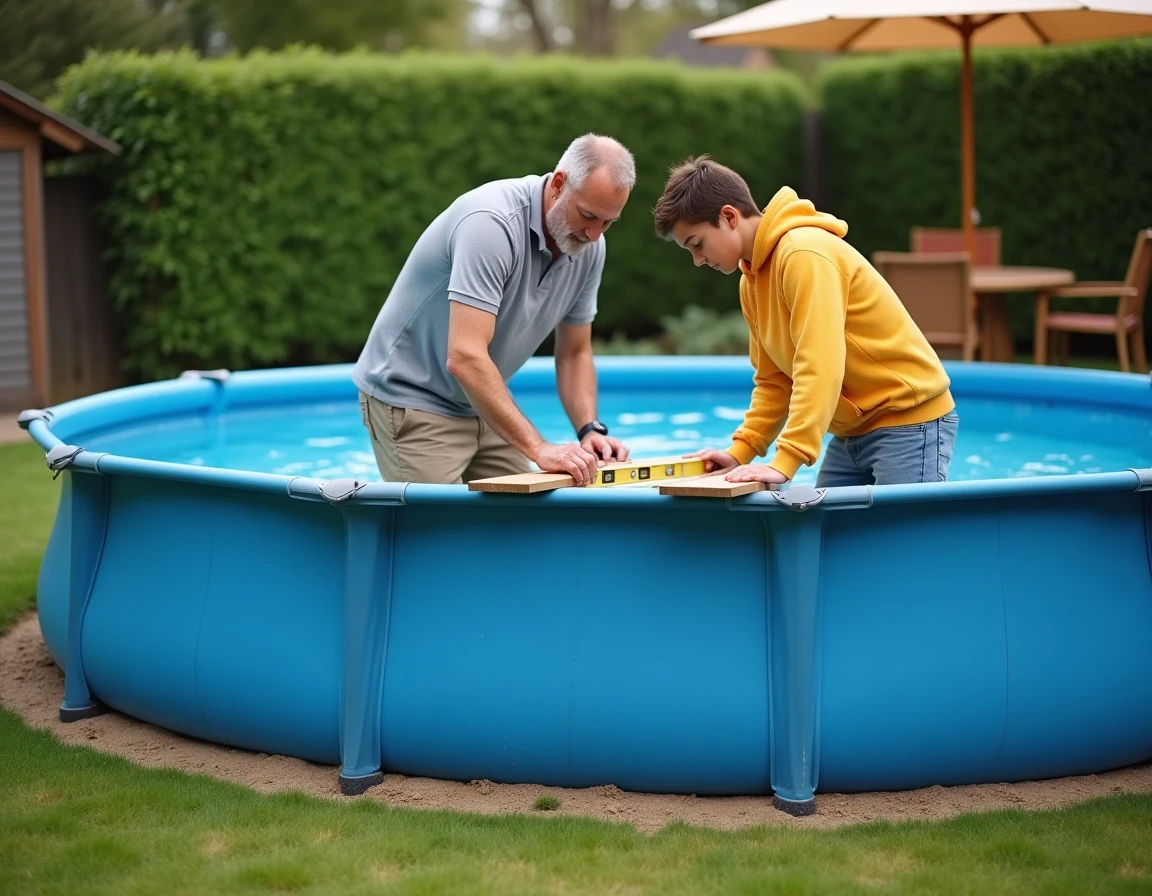
For minor tilts (less than one centimeter), the principle is to gradually raise the legs on the low side without abruptly lifting the structure. There are several approaches to straighten a full tubular pool without draining it, but they all share the same logic: work in small increments.
Choosing the shimming material
Field reports published by pool technicians in recent years show a clear shift towards high-density foam boards or insulating slabs under the metal legs. These materials distribute the load better than traditional wooden shims, which tend to split or tip under weight.
- High-density polyethylene foam slabs absorb ground irregularities and limit the punching of the metal foot into soft soil.
- Hardwood shims (oak, beech) remain usable on stable, dry ground but must be wider than the base of the foot to avoid any tipping effect.
- Concrete blocks or bricks, often recommended on forums, pose a risk of cracking under concentrated load and can damage the liner in case of accidental contact.
Progressive raising procedure
The raising is done foot by foot, starting with the one that has the smallest gap. The shimming material is slid under the base of the foot, slightly digging the adjacent ground if necessary. This operation requires at least two people: one to monitor the water level at the top of the structure, and the other to intervene on the ground.
Never use a jack or pry bar under a full pool. Technicians and excavators report that these attempts cause micro-cracks on the welds of the tubes, sometimes not immediately visible. The damage appears weeks later in the form of gradual leaks or deformed tubes that cannot be properly disassembled at the end of the season.
Manufacturer’s warranty and home insurance: what DIY can void
Most manufacturers of tubular pools (Intex, Bestway, and others) condition their warranty on strict adherence to the installation instructions in the manual. Among these instructions: assembly on perfectly level ground and complete draining before any structural intervention.
A straightening performed on a full pool, even if visually successful, constitutes a non-compliant intervention according to the manufacturer’s specifications. In the event of subsequent breakage of the liner or a tube, the manufacturer’s warranty may be denied for improper installation.
Home insurance coverage
The insurance aspect is more concerning. In recent years, home insurers have increasingly refused to compensate for damages related to the sinking or breakage of tubular pools, citing a manifest defect in installation on level ground. Feedback from homeowners on support groups confirms this trend.
In practical terms, if a poorly shimmed tubular pool collapses and floods the neighbor’s garden or damages a terrace, the expert appointed by the insurer will look for the cause. An uneven ground, makeshift shims, or signs of manipulation under the feet are enough to characterize negligence and exclude the claim from coverage.
Soft ground, hard ground, lawn: adapting the correction to the type of terrain
The ground under the pool determines the applicable method. On clay soil or wet grass, the legs naturally sink unevenly over the weeks. Adding shims without addressing the cause is merely postponing the problem.
- On grass or soft soil, the only durable correction is to partially drain the pool (to a height that sufficiently reduces the load), then reposition each leg on a rigid slab placed level.
- On concrete slabs or tiled terraces, a level defect is fixed: point shimming of the lowest legs with high-density foam boards works, provided the gap remains minimal.
- On a sand bed, leveling can be adjusted locally by moving the sand under the feet with a flat trowel, without lifting the structure.
In all cases, a level check should be repeated every week during the first month following the correction. A ground that has moved once is likely to move again, especially after episodes of rain.
Straightening a full tubular pool remains a corrective operation, not a long-term solution. If the tilt exceeds the threshold tolerated by the manufacturer or if the ground is structurally unstable, draining and reworking the ground remains the only option that preserves both the structure, the warranty, and the insurance coverage.